


“Ramadan is the month in which the Quran was revealed as a guide for humanity…” (Surah al-Baqarah: 185)
Ramadan 2026
TARAWEEH 2026
Please help us maintain a peaceful and respectful environment during Tarāwīḥ prayers by following the guidance below:
1. Parking :
Please park only in designated areas as directed by security. This will help us accommodate everyone safely and prioritise our vulnerable guests.
2. Security staff :
Please follow the instructions of our security team. They are fully trained, familiar with the site logistics, and acting in accordance with guidance from management.
3. Conduct :
Please be polite and courteous at all times. Rude or abusive behaviour is not in keeping with Islamic manners.
4. Neighbours :
Please be considerate of our neighbours and keep noise levels to a minimum. Respecting neighbours is a clear teaching of our religion, and they have rights in Islam.
5. Cleanliness :
Please dispose of all rubbish in the bins provided. Cleanliness is an important part of faith.
6. Children attending Tarāwīḥ:
Ages 15 and above:
May attend alone but must pray with the congregation. Non-compliance may result in not being permitted to attend for the remainder of the month.
Ages 7–14:
Must be accompanied by an adult and pray alongside them. If left unsupervised or disruptive, they may not be permitted to attend for the remainder of the month.
Under 7:
Permitted on the men’s side only, must be accompanied by an adult, and must pray alongside them.
Feedback:
Please email info@bmhc.org.uk
Ramadan Qaris
Dr. Hassan bin Mohammed Al-Fadel
Dr Mohammed bin Suleiman Almuhanna
Abdulrahman Hameed
Ramadan Q&A
Allah says in the Qur’an the main reason fasting was prescribed is so that we may develop
Taqwa (God-consciousness). Fasting also trains the soul in patience, discipline,
gratitude, and empathy for the poor.
Fasting is obligatory for every adult, sane Muslim who is physically able to fast.
Those excused include:
Those excused include:
- The sick (temporarily or permanently)
- Travellers
- Menstruating women
- Women in postnatal bleeding
- Pregnant or breastfeeding women (with conditions)
The fast is broken by:
- Eating or drinking deliberately
- Intercourse
- Vomiting intentionally
- Menstruation or postnatal bleeding beginning
- Taking nutrition through IV or feeding tubes
Suhoor is the pre-dawn meal before the fast. It is Sunnah and contains blessing. The
Prophet ﷺ said: “Take Suhoor, for in Suhoor there is Barakah.” (Bukhari & Muslim)
Iftar is the meal that breaks the fast at sunset. It is recommended to break the fast with
dates and water, following the Sunnah of the Prophet ﷺ.
Laylatul Qadr (The Night of Power) is the most blessed night of the year, better than 1,000
months. It likely falls in the last ten nights of Ramadan, especially the odd nights (21st,
23rd, 25th, 27th, 29th).
Zakat al-Fitr is a mandatory charity that must be given before Eid prayer near the end of
Ramadan. It purifies the fast and helps the poor enjoy Eid. It is usually paid in staple food
or its monetary equivalent.
Children are not obligated to fast, but many are encouraged to practice gradually,
especially from around age 7–10, depending on their ability.
You can maximise Ramadan by:
- Fasting sincerely for Allah
- Reading Qur’an daily with the translation
- Listening to more Islamic lectures and reminders
- Praying Taraweeh
- Giving charity regularly
- Making Duʿā’ often
- Avoiding gossip, arguing, and bad habits
No — brushing teeth does not break the fast, as long as you do not swallow toothpaste
or water. It is better to use a small amount of toothpaste and rinse carefully.
If fasting causes serious harm, severe dizziness, or risk to your health, you are permitted
to break your fast and make it up later. Islam prioritises health and does not require self-
harm.
If you miss a fast due to illness, travel, or a valid reason, you should make it up (qadā’)
before the next Ramadan. If you delay without excuse, most scholars say you should
make it up and give fidyah for each missed day.
Because in Ramadan:
- The gates of Paradise are opened
- The gates of Hell are closed
- The devils are chained
- Rewards for good deeds are multiplied
- Allah forgives those who sincerely repent
Yes — using perfume, deodorant, and showering does not break the fast. You may also
rinse your mouth and nose for Wudu, but avoid swallowing water.
There is no specific Duʿāʾ that is authentically reported from the Prophet ﷺ for “starting”
the fast.
What is required is the intention (niyyah) in the heart before Fajr — for example. This should not need to be said out loud.
There is an authentic Duʿāʾ recommended to retite after breaking the fast at Ifṭār. The Prophet ﷺ said:
ذَهَبَ الظَّمَأُ ، وَابْتَلَّتِ الْعُرُوقُ ، وَثَبَتَ الأَجْرُ إِنْ شَاءَ اللهُ
“Dhahaba al-ẓamaʾ, wabtallat al-ʿurūq, wa thabata al-ajru in shāʾ Allāh.”
“The thirst has gone, the veins are moistened, and the reward is confirmed, if Allah wills.” (Abu Dawood).
What is required is the intention (niyyah) in the heart before Fajr — for example. This should not need to be said out loud.
There is an authentic Duʿāʾ recommended to retite after breaking the fast at Ifṭār. The Prophet ﷺ said:
ذَهَبَ الظَّمَأُ ، وَابْتَلَّتِ الْعُرُوقُ ، وَثَبَتَ الأَجْرُ إِنْ شَاءَ اللهُ
“Dhahaba al-ẓamaʾ, wabtallat al-ʿurūq, wa thabata al-ajru in shāʾ Allāh.”
“The thirst has gone, the veins are moistened, and the reward is confirmed, if Allah wills.” (Abu Dawood).
A: Zakat al-Fitr is a charitable obligation due at the end of Ramadan, paid by every Muslim
who has enough food for themselves and their dependants on the day of Eid. It is given to
purify the fast from any shortcomings and to ensure the poor can share in the joy of Eid. It
can be paid any time from the beginning of Ramadan, but MUST be given before the day
of Eid, or at the very latest, before the Eid prayer on the day of Eid al-Fitr.

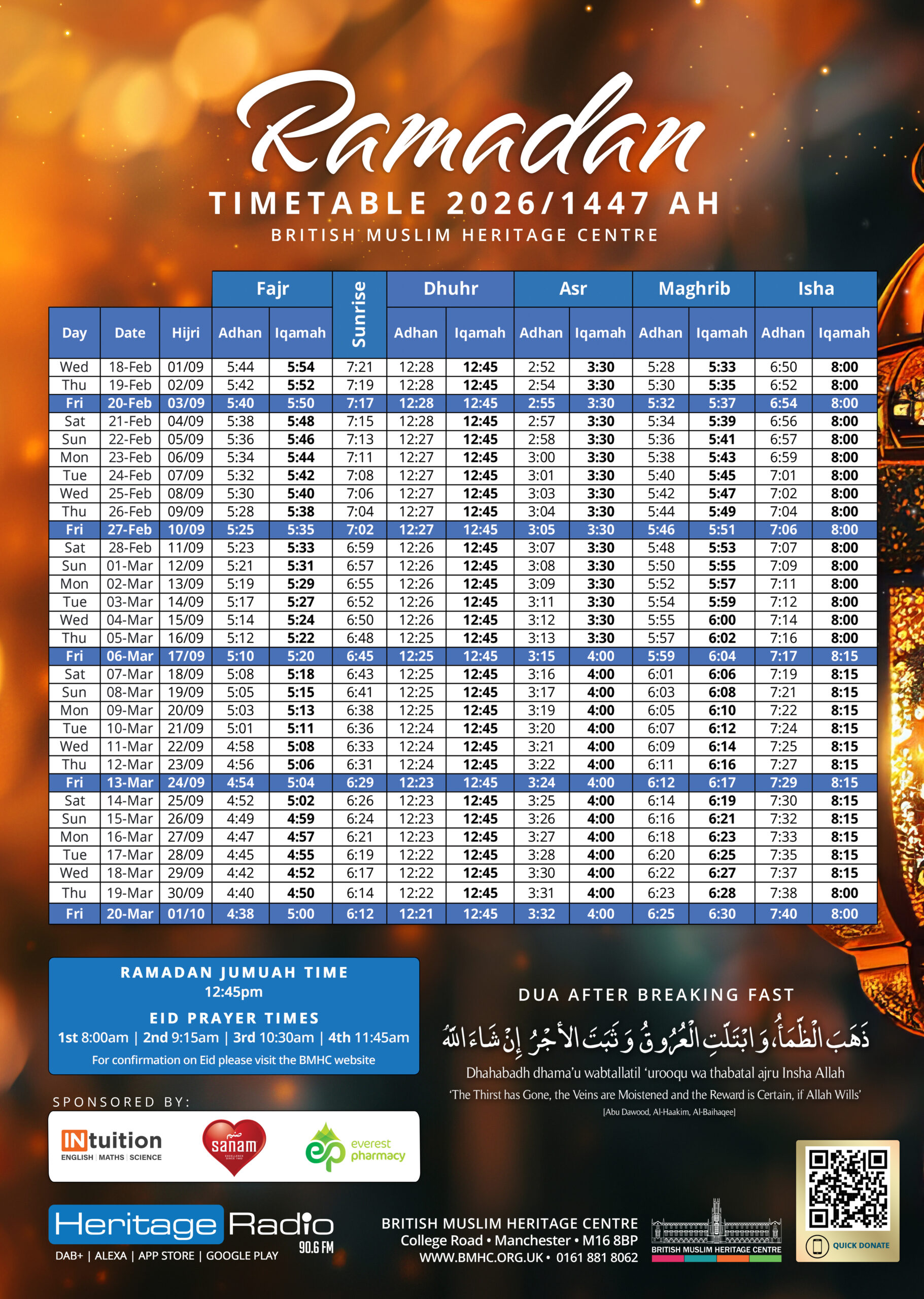
Taraweeh prayers at the BMHC will also be broadcasted live on Heritage Radio 90.6 FM every evening.
Please click on the button to download the Ramadan timetable.